
Petrol prices in September, and why this article is different
The ACCC’s weekly fuel price monitoring report dated 11 September 2026 shows Perth’s daily average retail petrol price at 216.4 cents a litre on 9 September. That is up from 192.2 cents on 2 August. Across the five largest cities, the average was 209.9 cents, up 5.3 cents in a single week.
Two things drove that rise. The full fuel excise came back into effect on 3 August, and international refined fuel prices climbed as conflict in the Middle East escalated. The spread between stations is also wide. On the morning of 9 September, Perth prices ranged from 193.3 to 231.9 cents a litre, so checking WA FuelWatch before you fill up still pays.
Our earlier article on rising fuel costs in Perth answered one question: how many litres, and how many dollars, a hybrid saves you each week.
This one asks a different question. Fuel savings only mean something once you weigh them against what switching costs you in weekly payments. A hybrid that saves you $80 a week in fuel does not help if it costs you $100 a week more to drive.
Adding up what you already spend
Before comparing a hybrid, work out what your current car actually costs you each week. It is more than fuel.
Add up your weekly car payment (if you are financing or renting), comprehensive insurance, registration, servicing, tyres, and any extra insurance cost for rideshare use. If you already pay an all-inclusive weekly rate that bundles the car, rego, insurance and servicing, do not add those costs again. They are already counted.
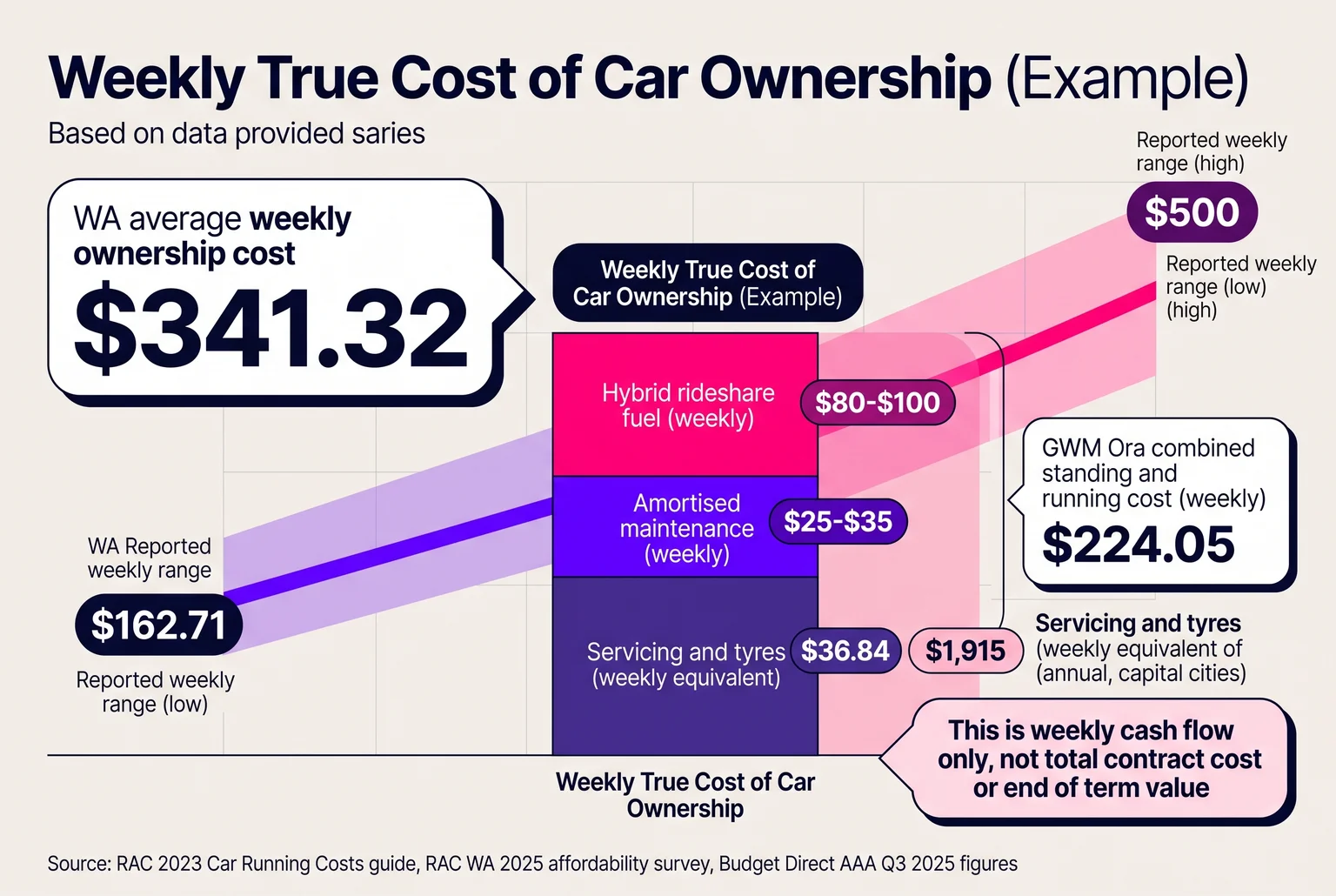
RAC WA’s 2025 affordability survey puts the average weekly cost of owning and running a car in WA at $341.32. Your own figure could sit well above or below that, depending on the car, your loan, your insurance and how far you drive. Rideshare use usually pushes insurance up, and our guide to insuring your car in Perth explains why.
An average is a starting point, not your number. Pull out your own bank statements and policy documents before you compare anything.
One more thing to keep in mind: this is a weekly cash flow comparison. It does not account for the total contract cost over the full term, or what your car will be worth (or what you will still owe) at the end. Both matter when you are deciding between two vehicles.
Fuel savings by weekly distance
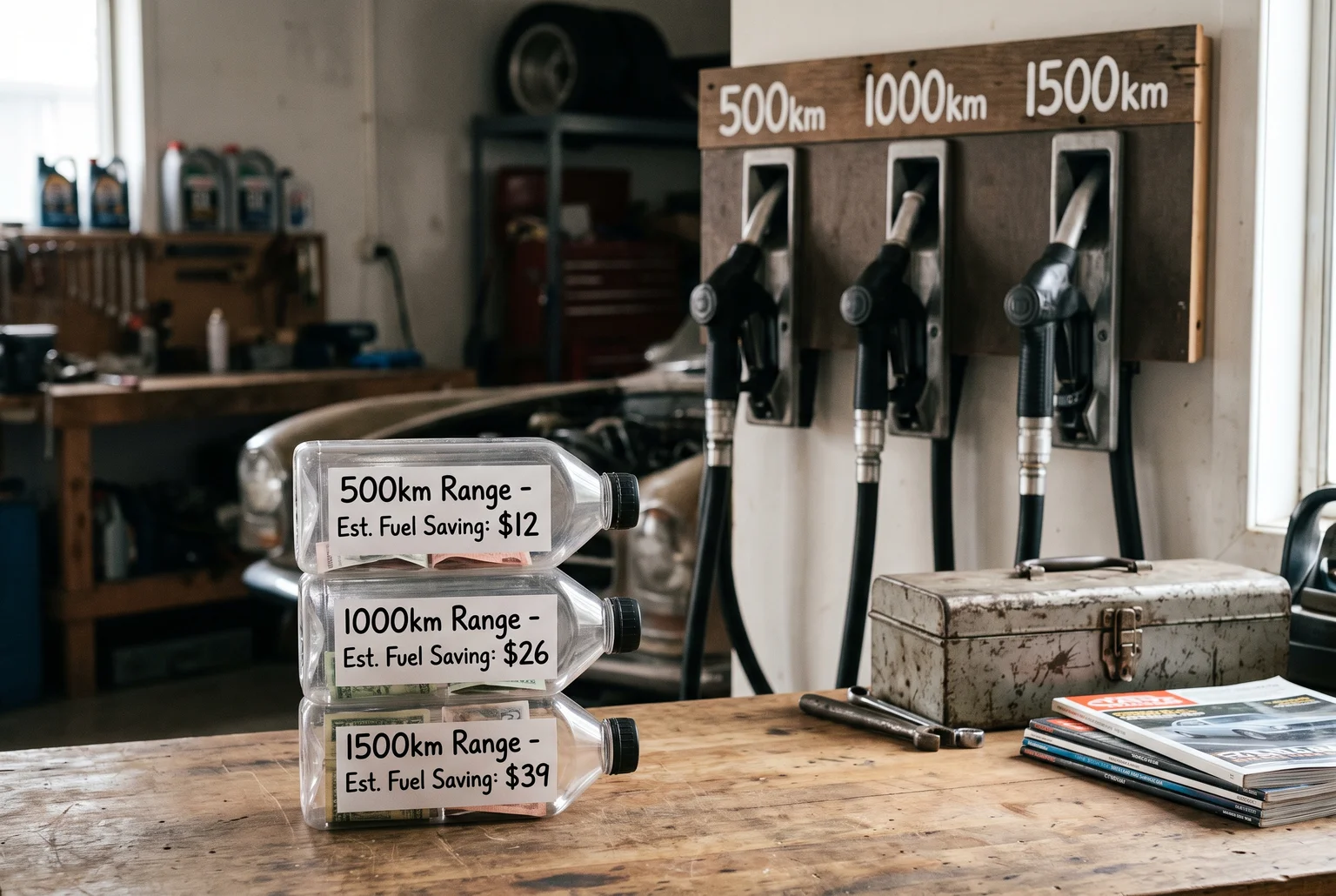
Using Perth’s 9 September average of about $2.16 a litre, here is a rough comparison between a conventional petrol sedan using around 8 L/100km and a hybrid using around 4.5 L/100km. These are not test results for a specific car. They are a simplified comparison to show how the savings grow with distance.
| Weekly distance | Petrol cost (8 L/100km) | Hybrid cost (4.5 L/100km) | Weekly saving |
|---|---|---|---|
| 500 km | $86.40 | $48.60 | $37.80 |
| 1,000 km | $172.80 | $97.20 | $75.60 |
| 1,500 km | $259.20 | $145.80 | $113.40 |
The saving grows in step with distance. A driver doing short local trips a few days a week sits at the low end. Someone driving full-time for Uber or DiDi, covering 1,000 to 1,500 km, is looking at roughly $75 to $113 a week back in their pocket, before any change in car payment.
These figures are illustrative only. Your actual fuel use depends on the model, your driving style, traffic and how much you run the air conditioning.
The break-even calculation, step by step
A hybrid usually costs more per week than a comparable petrol car, whether you finance it, lease it or rent-to-own it. Some of that gap is in the payment itself. Some sits around it: insurance premiums can differ, servicing costs vary by model, and so does tyre wear. Registration is usually similar either way. Add these up and you get your total extra weekly cost, not just the difference in repayments.
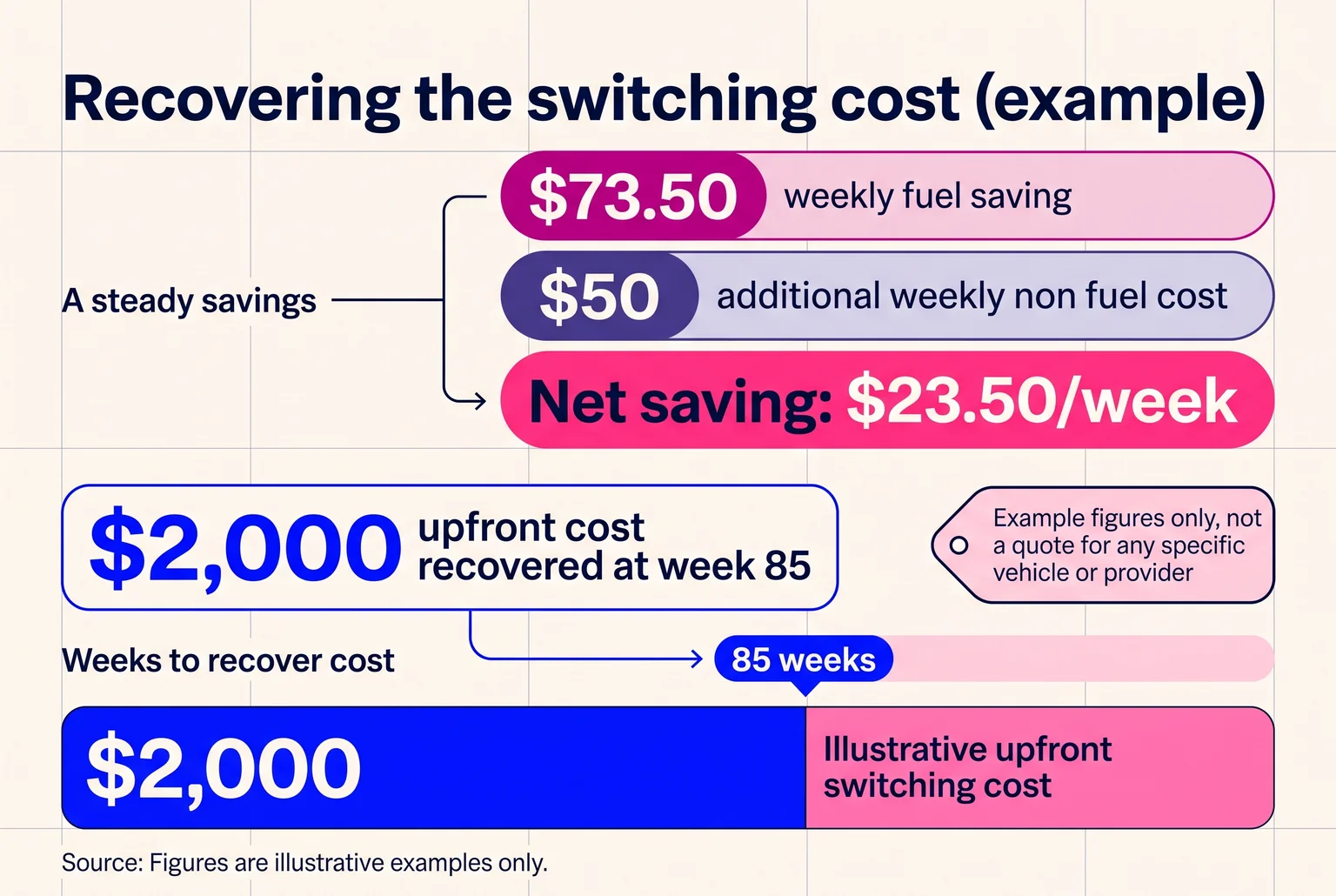
The break-even point is where your weekly fuel saving equals that total extra cost. Below it, switching costs you money each week. Above it, switching improves your cash flow.
Here is how it works for the 1,000 km a week driver from the table above:
- Weekly fuel saving: $75.60.
- Extra weekly cost of the hybrid (payment, insurance, servicing and tyres combined): say $50.
- Real weekly improvement: $75.60 minus $50 leaves $25.60.
- Upfront cost: if getting into the hybrid needs a deposit or fees of, say, $2,000, divide that by the weekly improvement.
- Weeks to recover it: $2,000 divided by $25.60 is about 78 weeks, assuming the saving holds steady.
These figures are examples only, not a quote for any vehicle or provider.
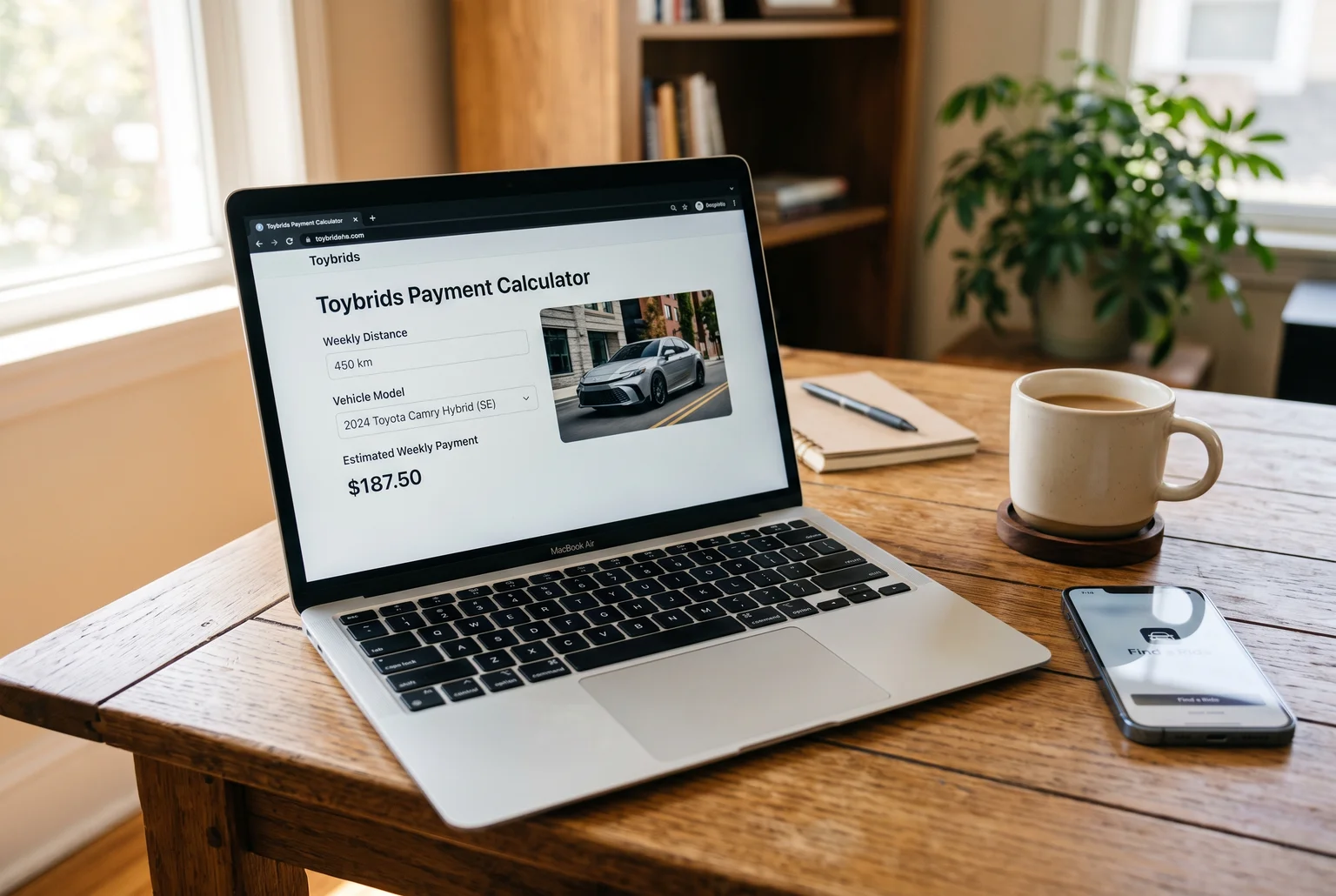
Before deciding, check what the switch actually costs upfront, not just the advertised weekly number. Toybrids hybrids vary in weekly price and deposit, and the rent-to-own calculator shows the weekly payment, deposit and a full cost breakdown for each car in the yard.
Not every driver should switch
If your car is paid off and you drive under 500 km a week, the maths usually works against you. A paid-off car has no weekly repayment to offset, so a hybrid adds a new cost with nothing equivalent saved. A saving of under $40 a week takes a long time to recover an upfront deposit. If you plan to cut your hours or leave rideshare within a year or two, you may never reach break-even.
The same applies if most of your driving is on the highway. Hybrids save the most fuel in stop-start city traffic, and that advantage shrinks at steady highway speeds. Your break-even numbers will look worse than a city driver’s.
None of this means hybrids are a bad choice. It means the answer depends on your weekly distance, whether your current car is paid off, and how long you plan to keep driving.

Run your own numbers before deciding
The figures in this article are illustrative. They are not a quote for any vehicle or a guide to today’s price at your local station. To get real numbers, use the Toybrids rent-to-own calculator to see the deposit and weekly payment for models like the RAV4 Hybrid, Kluger Hybrid or Yaris Cross Hybrid, then set those against your own weekly fuel bill. You can also read our breakdown of the weekly cost of a RAV4 Hybrid.
Before you sign anything, ask exactly what the weekly figure includes, particularly comprehensive insurance and registration, so you are comparing like with like.
Sources
- Fuel price monitoring during the current Middle Eastern conflict, ACCC (weekly report, 11 September 2026)
- Electric and hybrid cars dominate RAC affordability survey, RAC WA